Midi-Serial interface and conection with EMinEx software


2 weeks 3 days ago #282
by ludojoey
Midi-Serial interface and conection with EMinEx software was created by ludojoey
Hi!
Following Franck's modification of the MidiUpdt function, which can now retrieve the raw bytes exactly as they are received, I have made further progress on my Videotex (Minitel) emulation program, EMinEx.
A simple way to connect the Micro-8 to the Internet is to use an ESP32 running the Zimodem firmware, connected to the Micro-8's MIDI-IN and MIDI-OUT ports.
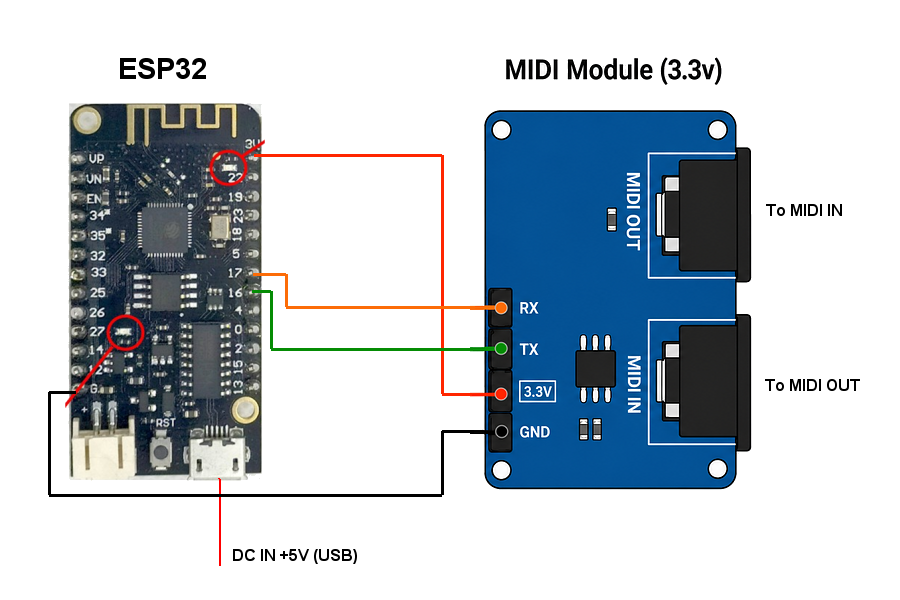
1- The MIDI interface
The first step is to build or obtain the interface that connects the Micro-8's MIDI ports to the ESP32.
I used a 3.3 V MIDI-Serial interface. It connects on one side to the Micro-8 and on the other side to the ESP32.
For the ESP32, I used an ESP32 Lolin32 development board, available for example here:
www.amazon.es/AZDelivery-desarrollo-Loli...etooth/dp/B086V1P4BL
It cost about €5 at the time of writing (09/2026).
Other equivalent ESP32 development boards should of course work as well.
For the MIDI-Serial interface, since I am not particularly skilled at electronics (soldering and I are not exactly best friends!) I chose to buy a ready-made board:
lectronz.com/products/midi-serial-interface-3-3v
As far as I know, this board is equivalent to the DIY circuit described in this tutorial:
electroniqueamateur.blogspot.com/2023/09/fabrication-dun-module-midi-in-et-out.html
2. The Zimodem firmware
On the ESP32, I installed Zimodem, a firmware developed by Bo Zimmerman. It turns the ESP32 into a Wi-Fi modem controlled using Hayes-style AT commands.
I made a few modifications to the original firmware, including making 31250 baud the default speed. This is the speed imposed by the MIDI protocol and cannot be changed on the Micro-8's MIDI port.
This also ensures that the modem always starts at 31250 baud, even if a different speed was previously saved in its configuration.
My modified version of Zimodem is available here:
github.com/ludosevilla/Zimodem-serialMIDI
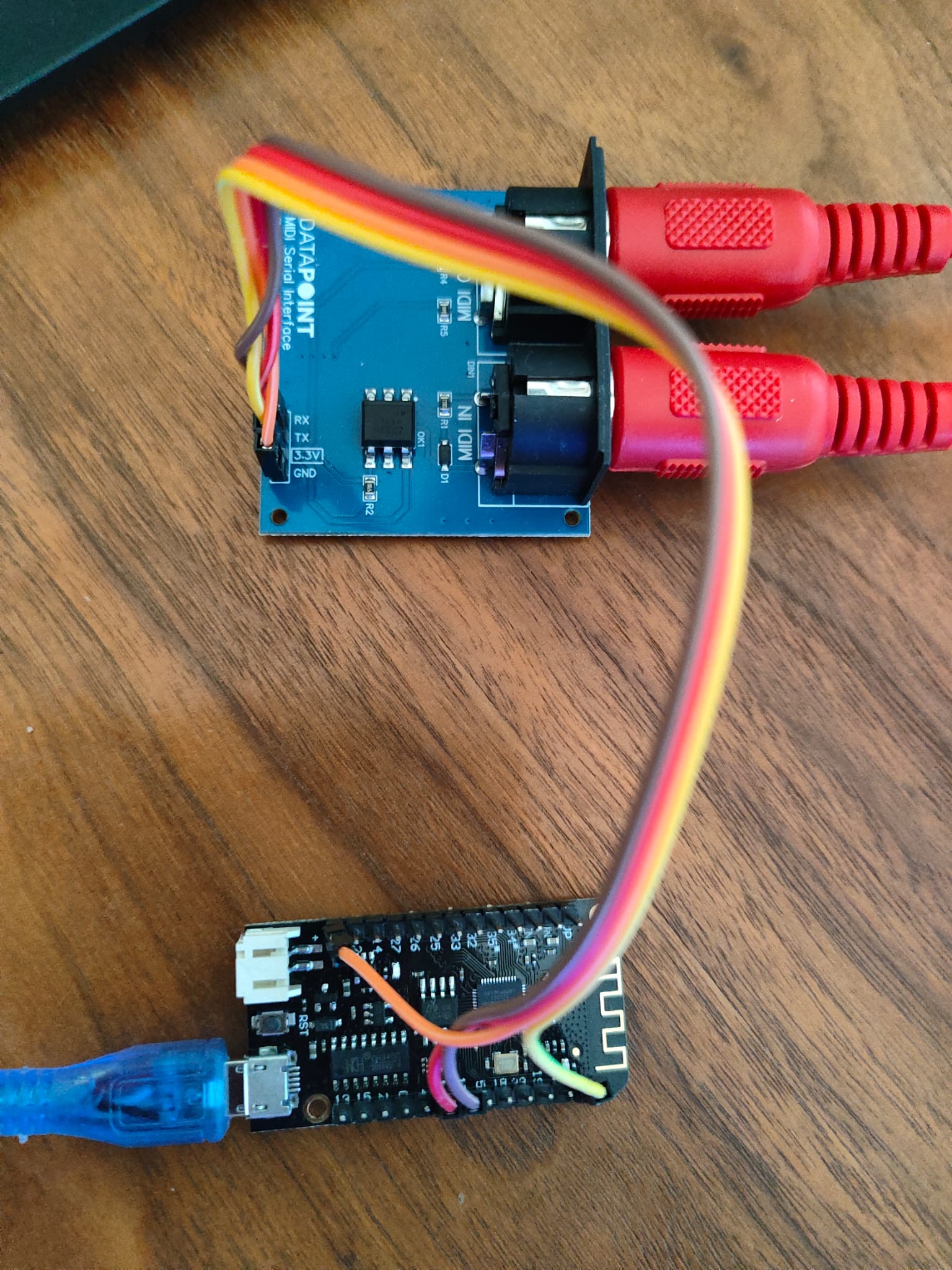
3. The hardware
The final setup looks like this:
4. Communicating with the Micro-8
I then continued the development of EMinEX to prepare version 1.0, which allows the Micro-8 to connect to the outside world through my MiniPavi gateway.
The program also provides a "Terminal" mode, which allows commands to be sent directly to the ESP32 modem. This makes it possible to test and configure the connection without going through EMinEX's higher-level functions.
Here is a demo video:
The next step would be to turn this setup into a nice plug-and-play enclosure!
That said, this really isn't my area of expertise... So if anyone feels like taking on the challenge, you're more than welcome!
New version of EMinEx (1.0) is joined to this message, but everything is available on my GitHub, here : github.com/ludosevilla/EMinEx-for-Micro-8
Following Franck's modification of the MidiUpdt function, which can now retrieve the raw bytes exactly as they are received, I have made further progress on my Videotex (Minitel) emulation program, EMinEx.
A simple way to connect the Micro-8 to the Internet is to use an ESP32 running the Zimodem firmware, connected to the Micro-8's MIDI-IN and MIDI-OUT ports.
1- The MIDI interface
The first step is to build or obtain the interface that connects the Micro-8's MIDI ports to the ESP32.
I used a 3.3 V MIDI-Serial interface. It connects on one side to the Micro-8 and on the other side to the ESP32.
For the ESP32, I used an ESP32 Lolin32 development board, available for example here:
www.amazon.es/AZDelivery-desarrollo-Loli...etooth/dp/B086V1P4BL
It cost about €5 at the time of writing (09/2026).
Other equivalent ESP32 development boards should of course work as well.
For the MIDI-Serial interface, since I am not particularly skilled at electronics (soldering and I are not exactly best friends!) I chose to buy a ready-made board:
lectronz.com/products/midi-serial-interface-3-3v
As far as I know, this board is equivalent to the DIY circuit described in this tutorial:
electroniqueamateur.blogspot.com/2023/09/fabrication-dun-module-midi-in-et-out.html
2. The Zimodem firmware
On the ESP32, I installed Zimodem, a firmware developed by Bo Zimmerman. It turns the ESP32 into a Wi-Fi modem controlled using Hayes-style AT commands.
I made a few modifications to the original firmware, including making 31250 baud the default speed. This is the speed imposed by the MIDI protocol and cannot be changed on the Micro-8's MIDI port.
This also ensures that the modem always starts at 31250 baud, even if a different speed was previously saved in its configuration.
My modified version of Zimodem is available here:
github.com/ludosevilla/Zimodem-serialMIDI
3. The hardware
The final setup looks like this:
4. Communicating with the Micro-8
I then continued the development of EMinEX to prepare version 1.0, which allows the Micro-8 to connect to the outside world through my MiniPavi gateway.
The program also provides a "Terminal" mode, which allows commands to be sent directly to the ESP32 modem. This makes it possible to test and configure the connection without going through EMinEX's higher-level functions.
Here is a demo video:
The next step would be to turn this setup into a nice plug-and-play enclosure!
That said, this really isn't my area of expertise... So if anyone feels like taking on the challenge, you're more than welcome!
New version of EMinEx (1.0) is joined to this message, but everything is available on my GitHub, here : github.com/ludosevilla/EMinEx-for-Micro-8
Please Log in or Create an account to join the conversation.
Time to create page: 0.197 seconds